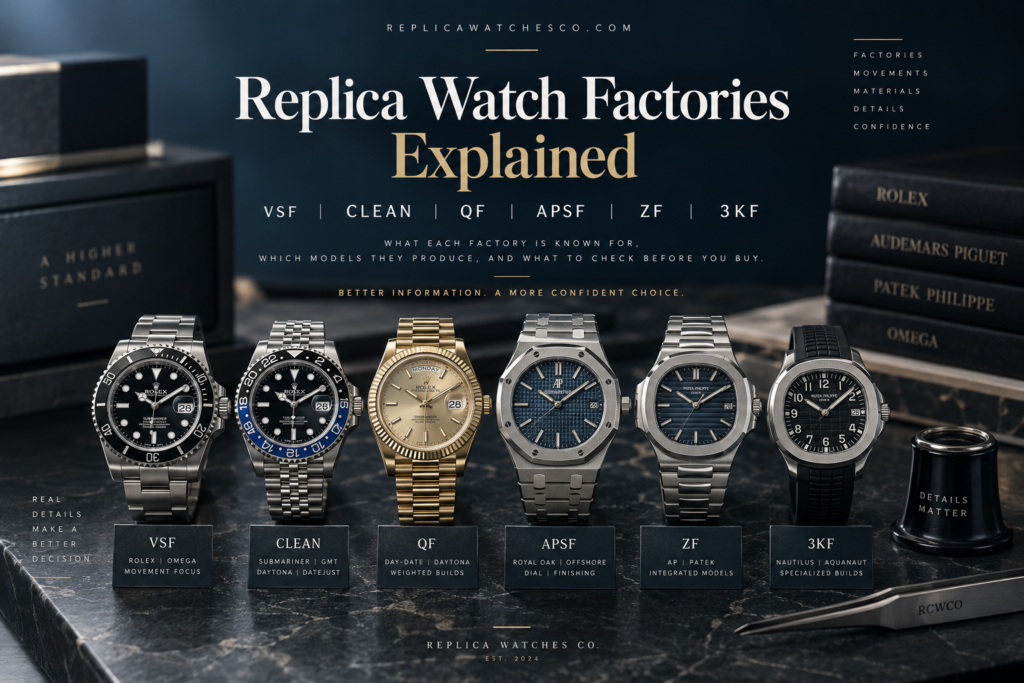
Factory names are everywhere in the replica-watch market.
VSF. Clean. QF. APSF. ZF. 3KF.
After a while, the abbreviations start sounding more important than the watch sitting in front of you.
That’s where buyers get into trouble. A factory name helps narrow the field. It can identify the version people are discussing, the movement commonly paired with it, or a batch known for changes to the bracelet, crystal, dial, or case shape.
It still doesn’t answer the question that matters most:
Is this particular version of this particular model any good?
Replica watch factories don’t perform equally across every reference. One may produce a convincing Submariner and an average Daytona. Another may be strongest on weighted Day-Date builds and have little reason to enter a Nautilus comparison.
The market shifts quickly, too. Batches are revised, suppliers change, production pauses, and familiar factory labels keep circulating even when availability becomes uncertain. Community discussions in 2026 show how fluid the situation is, especially around Clean Factory availability and APSF production status.
So this guide won’t declare one universal winner. It explains what the major replica watch factories are associated with, where each name becomes relevant, and what still needs inspection after you’ve chosen a factory.
The Quick Version
The short version is useful, as long as you don’t mistake it for a ranking.
- VSF / VS Factory: Usually discussed alongside Rolex sports models, Omega, and movement-focused builds. Pay close attention to movement behavior, the date, crown action, and case profile.
- Clean Factory / CF: Most commonly linked with the Rolex Submariner, GMT-Master II, Daytona, and Datejust. Inspect the bezel, dial, crystal, bracelet fit, and current batch identity.
- QF Factory: Known mainly for weighted Day-Date and Daytona builds. Check weight distribution, plating, dial, and movement version.
- APSF: Closely associated with Audemars Piguet Royal Oak and Royal Oak Offshore references. Bracelet finishing, case bevels, tapisserie dial, and movement deserve attention.
- ZF: Commonly discussed for AP, Patek, and other integrated-bracelet models. Look at dial texture, case thickness, and bracelet articulation.
- 3KF / 3K Factory: Focused more narrowly on Patek Philippe Nautilus and Aquanaut references. Check dial texture, case profile, movement, and bracelet or strap fit.
That list gets you into the right conversation. The useful comparison starts at the model level.
VSF: The Movement Usually Leads the Discussion
VSF built much of its reputation around watches where the movement matters almost as much as the exterior.
The name repeatedly appears beside Rolex references using 3235-style movements and in Omega discussions involving more model-specific movement layouts. Current factory guides still associate VSF with movement-focused Rolex and Omega builds.
For a Submariner, the checklist is fairly direct. Don’t stop at “VS3235” in a product description. See how the crown behaves. Winding should feel normal, setting positions should engage clearly, and the date should operate properly. Power reserve and timekeeping tell you more after a few days than a movement name printed on a sales page.
The same thinking applies to a GMT or chronograph. The factory label gets you into the right discussion; movement behavior tells you whether the individual watch belongs there.
Older VSF reviews also need a date attached to them. Production conditions and availability have changed, and current 2026 discussions don’t always agree about which references remain active or unchanged.
Clean Factory: Inspect the Exterior, Then Check the Batch
Clean Factory tends to appear in comparisons involving Rolex sports models: the Submariner, GMT-Master II, Daytona, and Datejust.
The interest is mostly visual. Clean has been associated with ceramic bezels, dial execution, case finishing, and the overall exterior presentation of Rolex models. Current guides still connect the name with those watches, although community discussion around current production and remaining stock has become less straightforward in 2026.
That uncertainty makes the buying lesson fairly simple: don’t buy the label. Buy the version.
Find out which batch you’re looking at. Is it current production, older inventory, or a watch being sold with familiar factory language despite a less certain origin? Then inspect the piece as you would any other watch.
On a GMT-Master II, check bezel color and transition, hand stack, local-hour setting, and bracelet fit. A Daytona deserves a look at dial spacing, pushers, subdials, and chronograph operation. With a Submariner, case profile, bezel, crystal, date presentation, and bracelet fit carry much of the visual impression.
A Clean sticker doesn’t settle any of those questions.
QF: Weight Is Only One Part of a Precious-Metal Build
QF stands out because its reputation grew around something product photos can’t show very well: weight.
Gold-tone and platinum-style Rolex models create a specific problem for replica manufacturers. A genuine precious-metal watch carries considerably more mass than a steel version. A replica can look convincing in a photograph and still feel surprisingly light as soon as you pick it up.
QF is strongly associated with weighted Day-Date and Daytona builds, including versions that use added mass or tungsten-based construction to bring the wrist feel closer to heavier precious-metal references. Current guides and marketplace listings repeatedly connect QF with those models.
Heavier isn’t automatically better. Balance still matters. A heavy watch head attached to a bracelet that feels too light can become more distracting, not less. Added mass also tells you nothing about dial color, plating quality, clasp construction, or movement serviceability.
If I were comparing a QF Day-Date, I’d check:
- total weight and where that weight sits
- bracelet balance
- gold-tone color under natural light
- clasp feel
- day and date alignment
- movement version
- dial texture, especially on meteorite or ombré styles
Recent owner discussions around QF Day-Date models have been positive about weight and wear. Even there, the movement and crystal can vary by version. “QF is good” is less useful than identifying what a particular QF version gets right.
APSF and ZF: Royal Oak Comparisons Put Finishing on Display
A Royal Oak exposes details a Submariner can hide. The bracelet is part of the case. Brushing runs across broad, flat surfaces, while polished bevels sit directly beside it. Bezel screws stand out. So do dial texture and thickness.
That’s why APSF and ZF comparisons spend so much time on finishing. Both names remain closely associated with Audemars Piguet Royal Oak and Royal Oak Offshore references, and current 2026 comparisons still place them beside each other on models such as the 15500 and related references.
Don’t reduce the comparison to the movement. Study the bracelet first. Does it articulate naturally? Are the polished transitions clean? Do the links feel sharp? Does the case sit too high on the wrist?
Then inspect the dial. Tapisserie texture is difficult to judge from one bright product photograph. Depth, spacing, and color can look different once the lighting changes.
Movement quality still enters the picture, especially on display-back models, but Royal Oak watches make exterior finishing and wrist feel impossible to ignore.
APSF also shows how uncertain factory status can become. Community posts in 2026 discussed raids, possible rebranding, and questions about whether newer watches carrying the APSF name came from the same production source. Recent QC is more useful here than an old reputation.
3KF: Patek References Reward Narrower Comparisons
3KF is much narrower, and that focus is part of its appeal.
The name is heavily associated with Patek Philippe Nautilus and Aquanaut watches, particularly models where case thinness, dial texture, and cloned movement architecture receive close attention. Current 2026 factory profiles continue to place 3KF around Nautilus and Aquanaut production.
On a Nautilus, thickness is hard to overlook. A watch can have a convincing dial and still feel wrong if the case becomes too bulky.
The bracelet carries a lot of the design. First links, clasp, taper, and overall articulation belong to the watch rather than acting like accessories added at the end.
Aquanaut references shift more attention toward the dial and strap. Embossed texture, color, and strap integration all affect how the watch comes across on the wrist.
Current comparisons also show that 3KF isn’t automatically the best answer for every color or Aquanaut reference. Newer alternatives such as DDF and BBF are being discussed for specific models. Factory loyalty is a poor substitute for comparing the exact reference.
Factory Names Describe Sources, Not Quality Grades
This is the part buyers often learn late.
VSF is not a standardized quality grade. Neither are Clean, QF, APSF, ZF, or 3KF.
These names identify production sources or projects within a fragmented manufacturing market. They’re useful because buyers and dealers use them consistently enough to compare versions. They aren’t certifications.
One current factory guide describes a label as a production recipe or supply chain, while the finished result still depends on the dial, case, movement, bracelet, assembly, and QC. That accounts for the small differences between two watches carrying the same name.
One bezel may align better. One date may sit more cleanly in the window. One bracelet may fit tighter at the end links. One crown may feel smoother.
The factory name narrows the search. Individual QC narrows the watch.
What I’d Check Before Choosing Any Factory
Start with the model you actually want. It sounds obvious, but it removes a lot of pointless comparison work. A buyer looking for a Submariner doesn’t need to spend two hours reading arguments about Nautilus factories.
Once the model is settled, narrow the configuration: size, dial, bracelet, bezel, and material. Then find out which factories currently produce that exact version. Only after that would I compare movement, finishing, and factory reputation.
When QC arrives, I forget the league tables for a moment and look at the watch.
Check the dial at normal size. Check the date. Check the bezel. Look at how the bracelet meets the case. If video is available, watch the crown and movement functions.
Chronographs need start, stop, and reset checks. GMTs need a look at the additional hand and local-hour behavior. On an AP or Nautilus watch, spend more time on side profile and bracelet articulation.
The factory name already did its job. It got you this far.
Which Replica Watch Factory Should You Choose?
There’s no useful answer without the model.
VSF may make sense in one Rolex comparison, while Clean matters more in another. QF becomes more interesting when weight is part of the purchase. APSF and ZF deserve closer attention for Royal Oak designs. 3KF becomes relevant once Nautilus and Aquanaut references enter the picture.
Next month, a revised batch could change one of those comparisons again.
That’s why ReplicaWatchesCo.com treats replica watch factories as part of the specification rather than the whole specification. Choose the watch first. Use the factory name to narrow the versions. Then judge the individual piece.
That order saves a lot of wasted research.