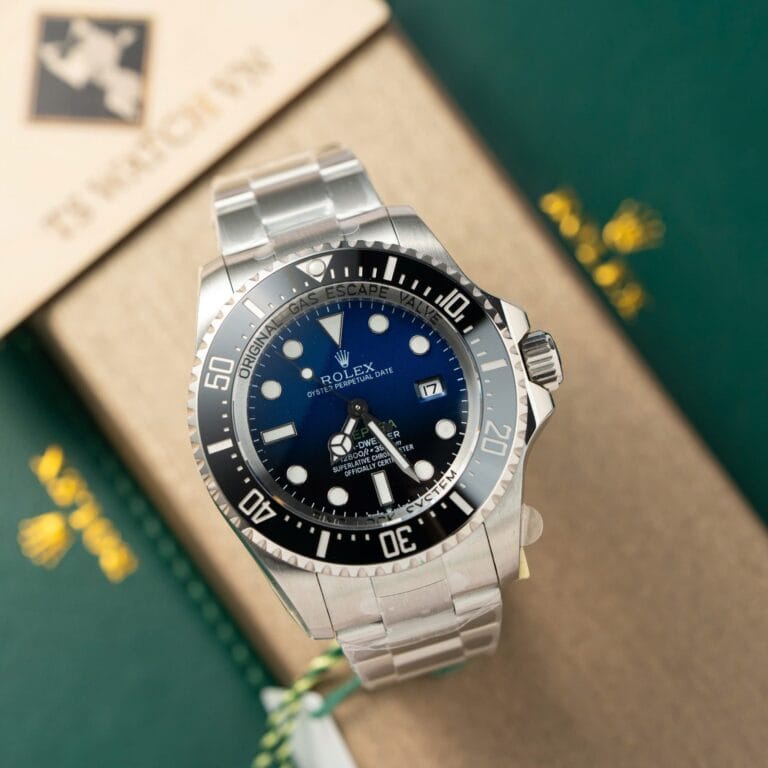
DeepSea
Rolex DeepSea 126660 (V9 Super Clone) 44mm 316L Stainless Steel Ceramic Bezel D-Blue Dial – Calibre 3235
44 mm
316L Stainless Steel
RLX-126660-1921
Call: +1 (800) 729-2661
sales@replicawatchesco.com
The Deepsea has too much case to hide bad proportions.
The bezel is wide, the crystal sits high, and the bracelet has to carry a heavy watch head. More metal surrounds the dial than on a Submariner. A Rolex Deepsea replica watch can show a convincing dial and still look wrong if the case profile is too tall, the bezel is too thick, or the bracelet looks undersized beside everything above it.
For ReplicaWatchesCo.com, the sensible comparison starts with scale. Get the overall shape right, then work inward to the bezel, dial, bracelet, movement, and factory version. Starting with tiny printing differences is backwards on this model.
The older 116660, later 126660, and current 136660 share the same basic identity, but they aren’t interchangeable. Case proportions, bracelet width, movement generation, and small visual details changed over time.
A 116660-style build should not be judged against 136660 photos alone. The bezel, bracelet, dial layout, and relationship between the case and dial are different enough to create a bad comparison.
Start by fixing the reference generation. Then compare watches built around that same reference. It sounds obvious, but it removes a surprising amount of confusion from replica listings.
The Deepsea isn’t trying to be subtle. The main line sits around the 44mm class, and its thickness is part of the design rather than an accidental side effect.
A replica that has been slimmed down too aggressively may look easier to wear in a product photo, but it loses the shape the model is supposed to have. Thickness alone doesn’t solve the problem, though. A case can be tall and still look wrong.
Look at the mid-case, crystal, bezel, and caseback as one arrangement. If one area is much thicker than the others, the watch starts to look like separate parts stacked together. Side-profile photos tell you more here than a clean, straight-on shot.
Buyers naturally focus on the bezel and dial, so the crystal gets overlooked. On a Deepsea, that leaves out a large part of the visible shape.
The crystal sits inside a substantial upper case structure. Its height changes the way the bezel and mid-case read from the side. Too high, and the watch looks awkward at an angle. Too low, and the upper case loses the raised, heavy profile associated with the model.
The ceramic insert, engraved numerals, and outer bezel edge should work with the crystal instead of fighting it. Straight-on images can make all three look acceptable. Tilt the watch slightly and poor proportions become much easier to see.
The Deepsea bezel is a large part of the front of the watch, not a narrow frame around the dial. Width, engraving, insert color, and the fit of the insert inside the bezel all deserve attention.
Check the minute markings and numerals for consistency. Then ask how much of the dial opening remains visible. If the bezel is too wide, the dial starts to look undersized. If the insert sits too deeply, the front of the watch can appear sunken.
A small difference in bezel weight changes the whole face because the watch is already built around scale. Look at the bezel in profile as well as face-up.
The standard black dial keeps the comparison fairly direct. The D-Blue version adds another variable: the gradient moves from blue into darker tones across the surface, so the transition itself becomes part of the judgment.
A weak gradient looks abrupt, with an obvious line between blue and black. A better one changes more gradually across the dial. Bright product photography can make the blue section look far stronger than it does indoors. Under softer light, the same dial may appear darker and more restrained.
One front-facing image isn’t enough for a D-Blue comparison. Look at several angles when possible and pay attention to how the color behaves once the lighting stops doing all the work. Black-dial versions have less color to inspect, so case and bezel proportions carry more of the visual burden.
The Deepsea has more structure around the dial than a normal Submariner-style watch. The visible inner ring changes how the dial sits inside the case, and it remains visible whenever you look at the watch.
Check that the ring looks even and that the printing doesn’t appear cramped or badly positioned. The transition from dial to inner ring, crystal, and bezel should read as one deliberate arrangement, not four layers placed on top of one another.
Some replica versions put most of their attention into dial printing while the surrounding structure receives less care. On a Deepsea, that compromise is hard to miss because the inner ring occupies so much of the viewer’s sightline.
End-link fit matters more on a Deepsea because so much visual mass sits above the bracelet. If the first links look narrow, loose, or poorly fitted, the watch becomes top-heavy before you even put it on.
Articulation is another test. The bracelet should move naturally enough that the watch doesn’t feel like a large block perched on a stiff metal band. Clasp construction also shows up quickly. The genuine Deepsea uses a substantial dive-watch clasp system, so a thin or loose-feeling clasp looks out of place.
A bracelet problem reaches beyond comfort here. It changes how the entire watch balances on the wrist, especially once the case, crystal, and caseback have added their share of weight.
A heavier Deepsea can feel more convincing because the genuine watch is already a large piece of steel. Still, a gram figure by itself tells you very little.
If most of the mass sits in the watch head while the bracelet feels unusually light, the result can feel awkward. A heavier bracelet may improve the balance, but only if its links and clasp still move properly. The highest listed weight is not automatically the best choice.
Look at where the weight comes from and how the case sits above the wrist. The Deepsea has enough case mass to expose a poor distribution quickly.
Most listings show the Deepsea face-up, which hides part of the story. The caseback contributes to overall thickness and affects how the watch rests against the wrist.
A caseback that protrudes too aggressively makes an already thick watch stand even higher. A flatter profile may wear differently, but it can also move the replica away from the reference. Side photographs show this relationship far better than another dial close-up.
On this model, the underside affects the visible silhouette more than buyers expect. It belongs in the first round of inspection, not as an afterthought.
The helium escape valve usually isn’t the first detail a buyer checks, but its position and fit should make sense within the side of the case. If it sits too proud or looks poorly integrated, the problem becomes obvious as soon as the watch is viewed from another angle.
The valve also shows why replica specifications need context. A replica can reproduce the visible shape of a professional dive-watch feature without matching the original engineering or depth capability. Visual similarity and tested performance are separate claims.
The genuine Deepsea is built around extreme water-resistance engineering. A replica may copy the external case architecture, bezel, valve, and dial language without being tested anywhere near the original specification.
A supplier title or product description should not casually transfer the genuine watch’s depth rating to a replica. If a particular version has been pressure tested, use the actual tested figure. If it hasn’t, the original rating doesn’t carry over by association.
The Deepsea looks like a serious dive watch. A copied exterior doesn’t automatically turn every replica into a serious diving instrument.
Higher-grade Deepsea replicas may use movements based around the generation associated with the reference being copied. That information belongs in the comparison, but it shouldn’t distract from a poor case.
A good movement inside a badly proportioned case doesn’t rescue the watch. Once the case and dial look right, check crown operation, date setting, time setting, winding feel, and power reserve.
The date deserves particular attention because the dial is already surrounded by so much structure. A badly centered date draws the eye quickly, even if the movement itself is otherwise suitable for the reference.
The Deepsea dial is cleaner than a chronograph dial, so the date receives more attention. Check how the number sits inside the window, and look at more than one date if possible.
Then inspect the Cyclops position. It should line up naturally over the date instead of sitting slightly high or off-center. On a large watch, fewer dial elements compete for attention. Small alignment errors therefore stand out rather than disappearing into the design.
Different factory names appear across Rolex Deepsea replica watches, and those versions can vary in case shape, bracelet, movement, dial execution, and overall weight. I wouldn’t begin with the factory label.
First fix the Deepsea generation, dial, case profile, bracelet, and movement type. Then compare which factory versions produce that combination. A D-Blue model may turn on the quality of its dial transition, while a black-dial version may be decided more by case and bezel proportions.
One factory name doesn’t solve every Deepsea reference. The watch still has to work as a complete build.
Start farther away than you think. Look at the complete watch before chasing small details.
Does the case look proportionate to the bracelet? Does the bezel overwhelm the dial? Does the watch look tall in the way a Deepsea should, or merely bulky? Those first impressions reveal problems that a magnified dial photograph can hide.
Move closer only after the overall shape makes sense. Check the bezel insert and engravings, crystal height, inner ring, dial, date, bracelet connection, and clasp. Then turn the watch sideways.
The side profile shows several things at once: crystal height, bezel thickness, mid-case shape, caseback depth, and the angle at which the bracelet leaves the case. Only after those checks would I spend much time worrying about tiny dial-print differences.
Fix the exact version before comparing listings:
Then compare watches built around the same configuration. A black-dial 116660 and a newer D-Blue 136660 are both Deepsea models, but they shouldn’t be judged with an identical checklist.
ReplicaWatchesCo.com carries Rolex Deepsea replica watches across different generations, dial configurations, movements, and factory versions. With this model, I start with the case. If the scale and proportions don’t work, smaller details won’t rescue it.
| Movement | |
| Case Material | |
| Diameter | |
| Thickness | |
| Bezel | |
| Crystal | |
| Power Reserve | |
| Waterproof |
Browse our collection of 1:1 CNC-milled clone timepieces and select a watch for precision regulation.
Explore The Collection →